BRUSSELS — The European Union has crossed a major diplomatic threshold by quietly hosting a five-member delegation of Taliban officials at its headquarters in Brussels. This marks the first time since the August 2021 takeover that representatives of the unrecognized fundamentalist regime have been received directly on EU soil. The secret talks have sparked intense backlash from human rights organizations, members of the European Parliament, and prominent activists, who condemn the event as a betrayal of Western values and a major step toward normalizing a regime accused of enforcing a brutal system of gender apartheid.
The meetings, which took place at an undisclosed location outside official European Commission offices to avoid the appearance of formal diplomatic recognition, were co-chaired by Commission services and Sweden. Representatives from 15 EU member states participated in the session. According to EU spokespeople, the summit was strictly confined to “technical-level” negotiations aimed at facilitating the deportation and readmission of Afghan nationals who have exhausted their legal right to remain in Europe, particularly those convicted of serious crimes or flagged as security threats.
The Driven Force: Domestic Migration Pressures
The primary catalyst behind this unprecedented dialogue is the mounting political pressure on European governments to accelerate migrant deportations. The European Commission maintains that practical engagement with the de facto authorities in Kabul is an unavoidable necessity, as forcing repatriations to Afghanistan remains logistically impossible without the direct cooperation of the Taliban’s border control and security apparatus.
The initiative is heavily championed by Germany, where the current administration faces extreme domestic pressure over migration issues. Berlin recently launched a coordinated “repatriation offensive” and is actively negotiating to allow additional Taliban consular officials into Germany to speed up the paperwork required for mandatory deportations. Other key European players, including France, Sweden, the Netherlands, and Austria, are similarly backing the initiative. Sweden, for instance, helped organize the meeting to resolve the status of roughly 200 Afghan nationals convicted of serious crimes currently awaiting deportation. According to Eurostat figures, while more than 14,000 Afghan nationals were ordered to leave EU member states during the first nine months of 2025 alone, only a small fraction have actually been successfully returned.
The Massive Risks: Exploitation and Normalization
While the EU attempts to frame the meetings as a narrow, non-political transaction, the Taliban has capitalized on the event as a historic public relations victory. Abdul Qahar Balkhi, the prominent spokesperson for the Taliban Ministry of Foreign Affairs who spearheaded the five-member delegation, explicitly labeled the visit as “historic” and celebrated the fact that the Islamic Emirate had successfully forced direct engagement with European member states.
Human rights advocates point out that the meeting exposes deep contradictions and dangers within European foreign policy:
The Legitimacy Trap: While the EU claims no political recognition occurred, Taliban officials openly stated that the Brussels summit included direct discussions regarding an expanded Taliban consular presence inside the EU and broader “trust-building measures”.
Violation of Non-Refoulement: Human rights watchdogs emphasize that returning individuals to Afghanistan constitutes a severe violation of international law. Under the core principle of non-refoulement, governments are explicitly prohibited from returning individuals to a country where they face a credible threat of persecution, torture, or extrajudicial killing.
The Fate of Returnees: Investigative reports by independent outlets reveal a grim reality for deportees. In past repatriation instances, arriving individuals were immediately met at Kabul hotels by Taliban intelligence vehicles. Taliban fighters photographed their documentation, subjected them to forced filmed interviews, and placed them under permanent armed guard, effectively transforming their return into immediate detention.
Persecution of Minorities: Religious freedom watchdogs warn that deportees belonging to vulnerable minorities face extreme danger. Under the Taliban’s radical interpretation of Sharia law, Afghan Christians (who are primarily converts from Islam) and Ahmadi Muslims face severe legal persecution, arbitrary imprisonment, and capital punishment upon discovery.
Accusations of “Moral Capitulation”
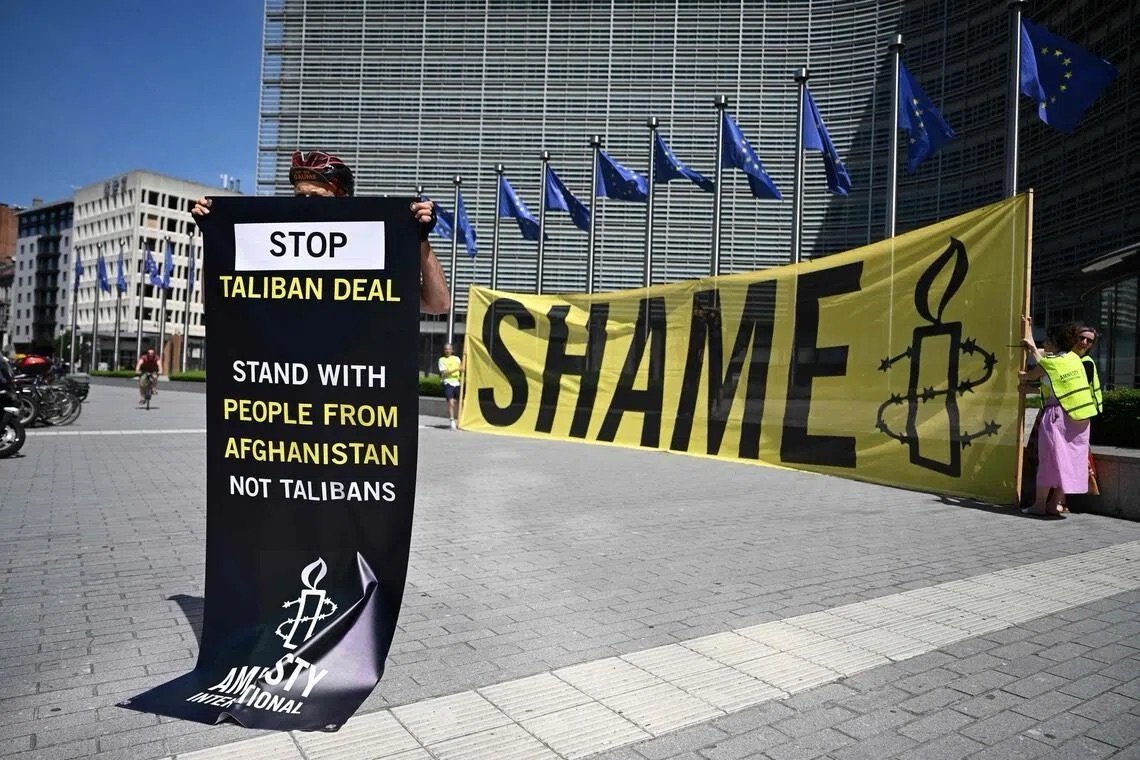
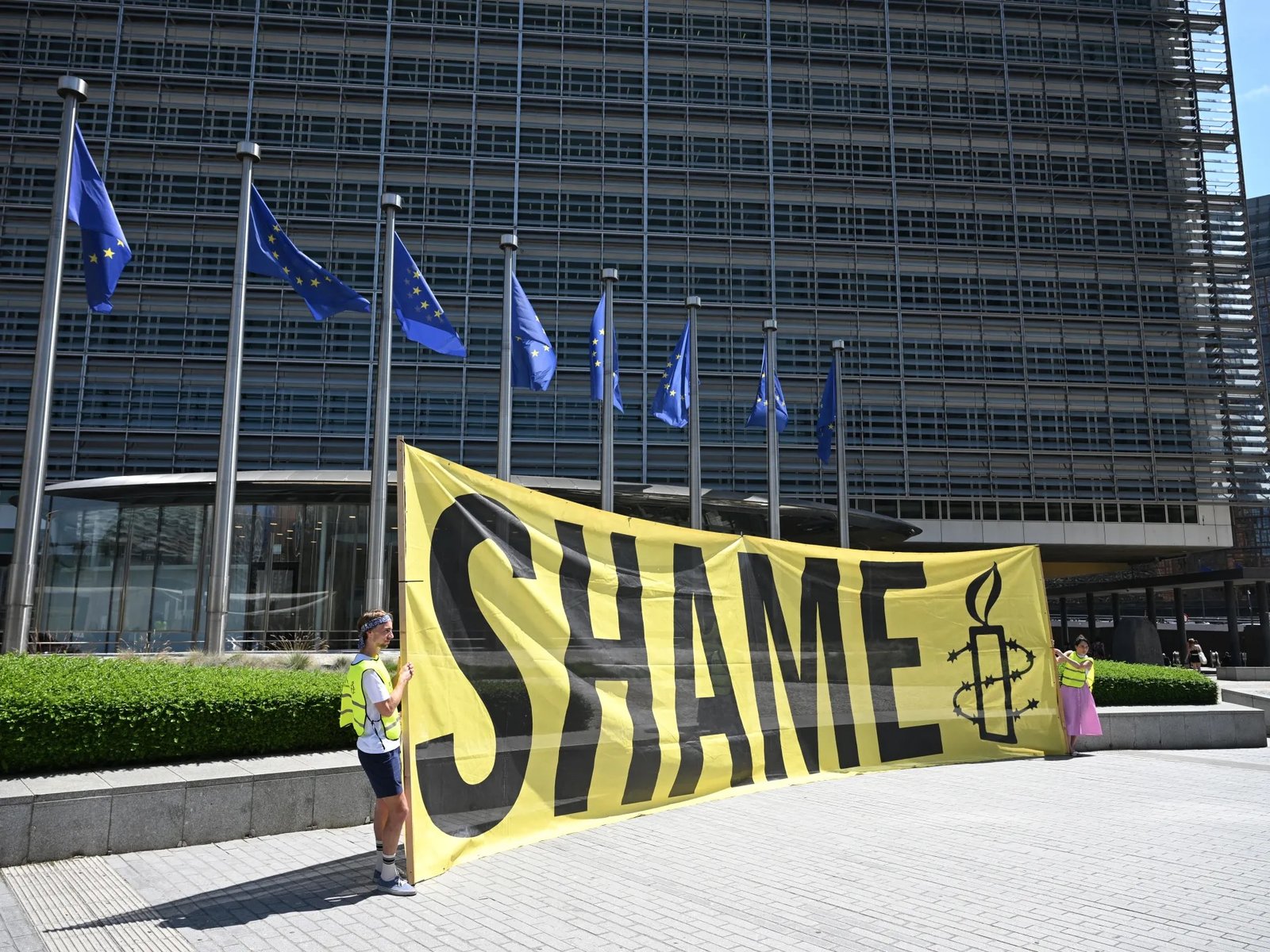
The summit has drawn fierce, public condemnation from global icons like Malala Yousafzai and major rights networks, including Amnesty International and Human Rights Watch. Activists gathered outside the European Commission headquarters holding banners reading “Shame,” accusing European leaders of treating the fundamental rights of Afghan women and minorities as expendable bargaining chips to satisfy domestic anti-immigrant voters.
“Those who have turned an entire country into a prison for women should not be rewarded with visas, meetings, and symbolic recognition,” noted Afghan journalist Khadija Amin in a biting review. Activists argue that the EU completely sabotages its own ethical credibility by publicly condemning Taliban human rights violations on the world stage while simultaneously shaking hands with those same perpetrators behind closed doors to orchestrate deportations. By opening the gates of Brussels to the Taliban, critics argue that European pragmatism has officially crossed the line into active complicity.